A useful way to check T-shirt length
Measure from the stated starting point, then check the hem against the way you actually wear your clothes.
Choose a useful reference shirt
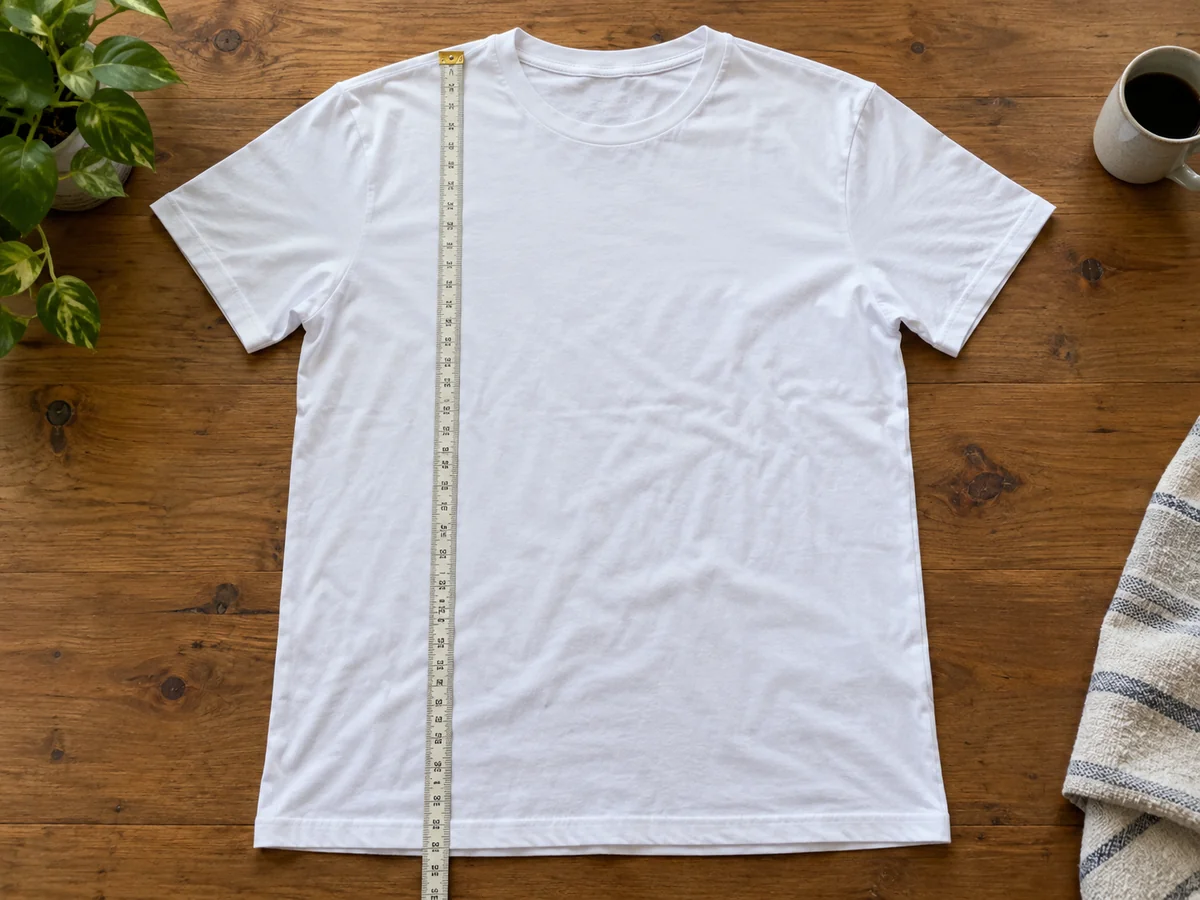
A T-shirt length measurement becomes more useful when you compare it with a shirt you already wear comfortably. Choose one that has been washed and dried in its normal way, not a new garment that has never settled into your laundry routine. Smooth it flat on a table without stretching the body or pulling the neckline into shape.
Read the new garment's measurement diagram before reaching for the tape. Many charts start at the high point of the shoulder beside the neck, but others use the centre back or a different point. Measuring from the wrong starting position can create an apparent difference that is only a difference in method.
Think in terms of the waistband
Decide whether the shirt will be worn loose, tucked or both. For a loose tee, inspect where the hem finishes relative to the waistband and pockets. A hem that reaches an inconvenient point on a trouser pocket can catch when you put your hand inside. Under a short jacket, the visible amount of shirt may be part of the look you want.
For a tucked tee, you need enough length to remain tucked during ordinary movement, but extra fabric is not always helpful. A long, heavy shirt can gather under the waistband. Try sitting down and reaching above shoulder height, then check whether you need to reset the tuck. This is a more useful test than deciding that longer automatically means safer.
Body shape affects how a nominal length appears. Fabric uses some of its length travelling over the chest and abdomen, so a shirt can sit higher at the front than a flat measurement suggests. A straight hem on a hanger does not guarantee an identical distance from the floor all around your body.
Allow for the cut and the fabric
A wide tee can drape differently from a narrow one even if both have the same recorded length. A curved hem may have a longer centre than side seam. Check whether the published number refers to the front or back when the garment has different lengths. Ask the seller if the diagram is ambiguous.
Treat small numerical differences cautiously. Manufacturing tolerances and your measuring technique can account for a little variation. If a centimetre decides whether a shirt is usable, look for a stated tolerance and a clear returns policy rather than assuming laboratory precision from a size chart.
Keep your reference measurements together with a quick note about use: works untucked with high-rise trousers, or stays tucked beneath an overshirt. Those notes preserve the reason a length worked. A number without that context is easy to copy into a different outfit where it no longer solves the same problem.
Further information