Separate travel essentials with a small pouch
Group travel items by the moment you need them, rather than putting every small thing into one organiser.
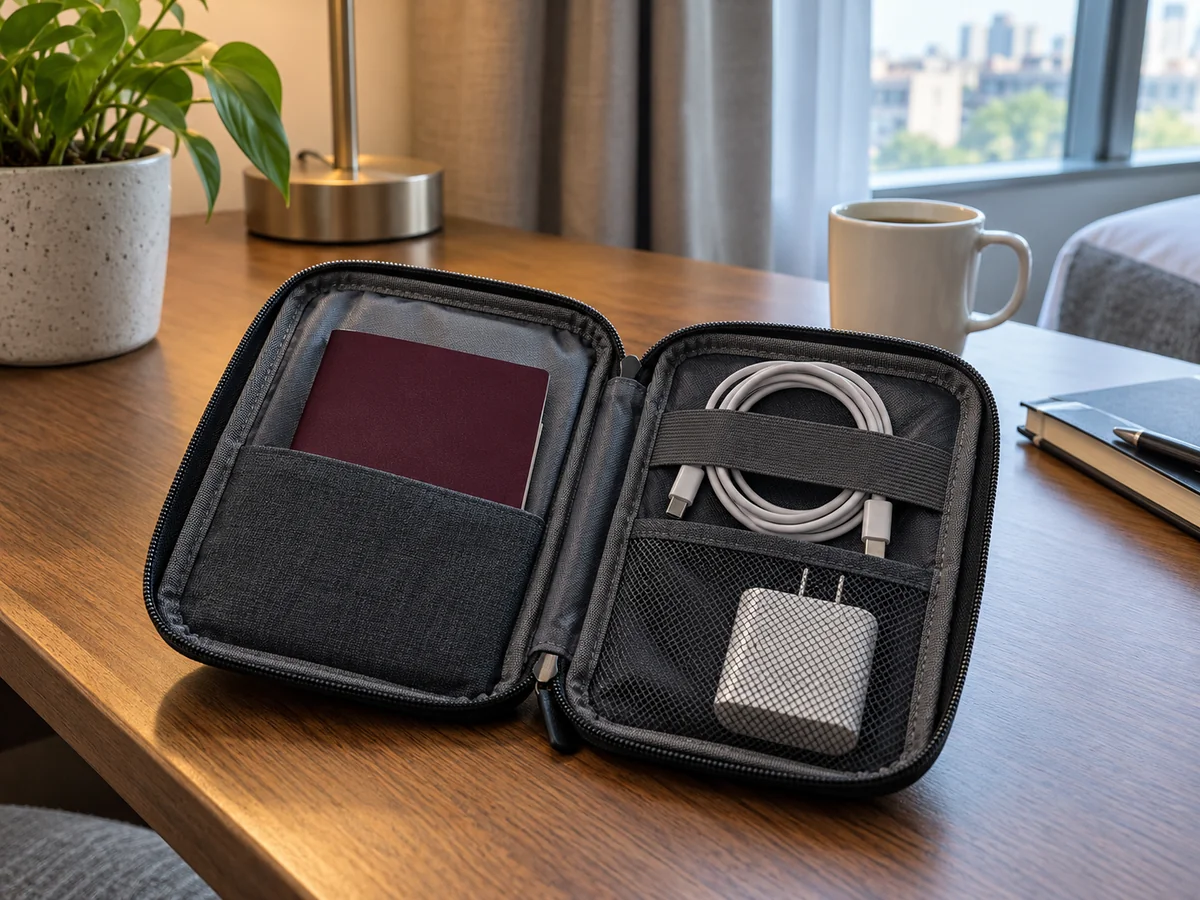
Make a pouch for one part of the journey
A travel pouch is most useful when you can name its job. It might hold the charging items used in a hotel room, the documents needed at a particular stage of a trip or the small everyday objects transferred between bags. Combining all three can produce a heavy, crowded organiser that has to be searched at exactly the moment it was meant to simplify.
Lay out the items for one task and leave unrelated extras aside. A charging pouch may need a cable, plug and adapter appropriate to the destination. A daily pocket pouch might need earbuds, a pen and a small notebook. Check compatibility before packing technical items: a neat collection of plugs is not useful if the connector or electrical requirements do not suit your equipment.
Put frequent access near the opening
The cable you remove repeatedly should not sit underneath a bulky power bank. Use pockets for items that benefit from a fixed position, but do not force every object into a loop merely because one is provided. A large plug may need an open compartment; a tiny adapter may be easier to identify in a small separate pocket. Try retrieving each item without emptying the rest.
Documents need their own dimensions and protection. Measure a passport or ticket holder with its cover attached and check the pouch's usable opening. Keep important documents under your control rather than treating a fabric zipper pouch as secure storage. A water-resistant exterior also does not promise protection from a leaking bottle or from prolonged rain through seams and zippers.
Keep inspection and rules straightforward
Travel requirements vary by route, carrier and destination. Check current official guidance for liquids, batteries, medication and other restricted items rather than assuming that placing them in a pouch makes them acceptable. Keep anything that must be presented separately accessible. Do not let a beautifully organised kit create a slow unpacking problem at a checkpoint or border.
Choose an interior you can inspect easily before leaving each location. Pale fabric, mesh pockets or a wide opening can help, depending on the contents. Count the essential pieces when repacking, and put charging equipment away only when dry and suitably cool. Close the pouch without compressing cables sharply around rigid objects or forcing the zipper over a raised plug.
Size the organiser for the bag it travels in. A large boxy kit can swallow useful space in a small day bag, while a flat pouch may disappear beneath clothes in a suitcase. You may need one compact everyday pouch and a separate trip-specific arrangement rather than a single universal kit. Keeping each one modest makes it easier to see what is present, what is missing and what never needed to travel.
Further information