Match notebook paper to your pen
Your pen and the paper form a pair. Weight is one clue, but coating, texture and drying behaviour decide much of the experience.
Bring the pen into the decision
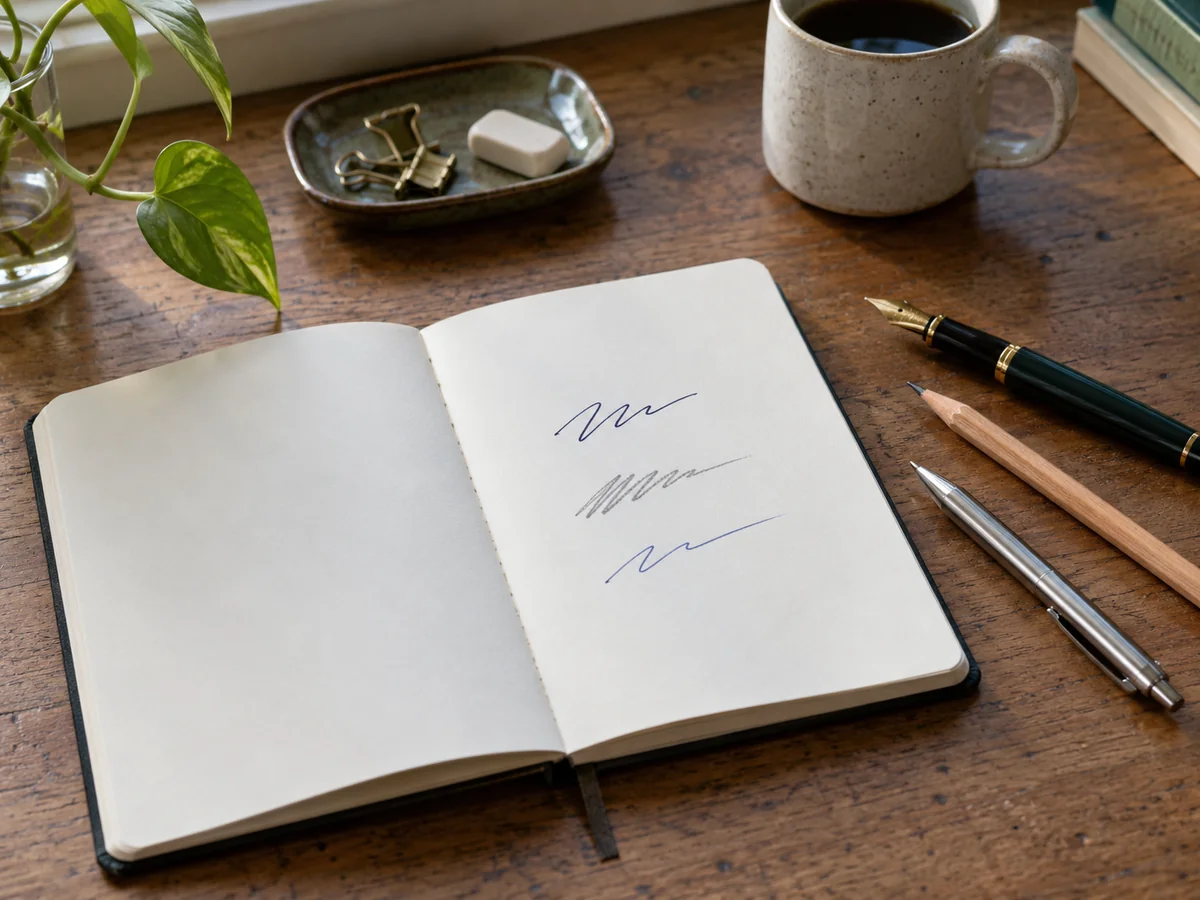
A notebook that feels excellent with a pencil can behave differently with a wet fountain pen or a marker. Think about the tools you use most often before choosing paper. A fine ballpoint, a gel pen and a brush pen leave different amounts of ink and respond differently to surface texture. If a shop offers a tester, use your usual pen with permission rather than borrowing an unfamiliar one and treating the result as decisive.
On a sample page, write an ordinary line, a short underline and a small filled area. Let them dry normally, then look at the reverse. Show-through means the writing is visible through the sheet; bleed-through means ink has travelled through it. Feathering describes ink spreading along the paper fibres around a line. These problems can occur in different combinations, so check the detail that actually bothers you.
Do not ask GSM to explain everything
Paper weight describes mass per area, not a complete writing performance. A heavier sheet can provide a substantial feel without necessarily accepting every ink well. Surface treatment, fibre composition and the pen's ink all affect the result. Compare the manufacturer's stated use and a real sample where possible. A claim that a notebook is suitable for fountain pens is still not a promise for every nib, ink and heavy application.
Drying time can be a trade-off. A surface that keeps ink near the top of the sheet may show a crisp line but need more time before the page is turned or touched. If you write quickly and close the notebook immediately, that matters. Left-handed writers may notice smudging especially, depending on their hand position. Test the movement you actually make, not only how a neat line looks once completely dry.
Choose for the pages you intend to make
For quick work notes, you may prefer lightweight paper and a book that is easy to carry. For drawings with wet media, look for a sketchbook specified for that purpose rather than expecting an ordinary notebook to cope. If you paste in tickets or other pieces, allow for the added thickness and choose an appropriate adhesive. Paper that takes writing well is not automatically designed for every craft technique.
Check the colour and ruling in ordinary light too. Bright white and cream paper can make the same ink look different, while a dark printed grid may compete with a fine pen line. One small notebook can be a sensible trial before buying several. The best paper is the one that supports your normal marks, lets you use both sides when you want to and dries in a way that fits the pace of your writing.
Further information