Choose hoodie weight for the room you use
The best hoodie for a warm room may be a poor layer for a cool walk. Start with the place it will spend most of its time.
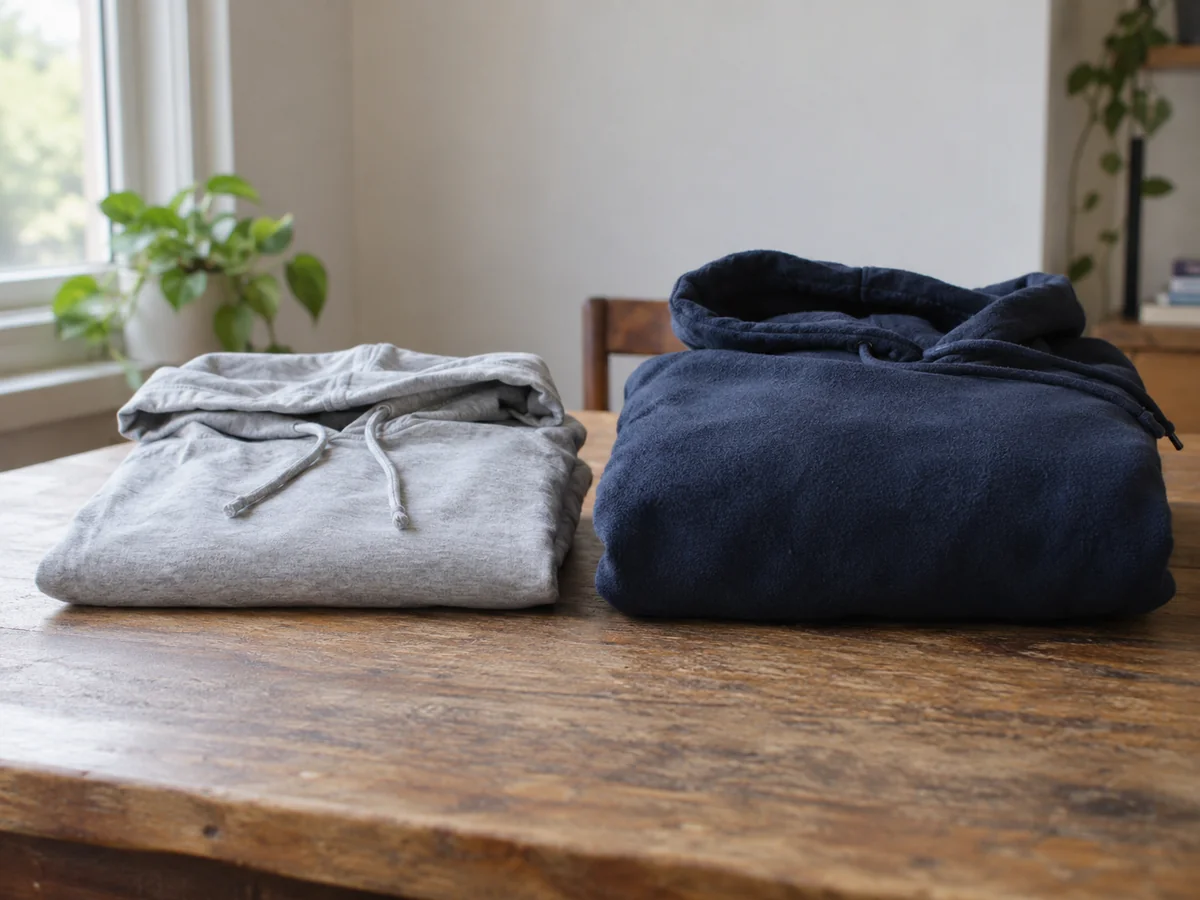
Choose the room, then the garment
A hoodie worn at a desk in a heated room has a different job from one used as an outer layer on a cool evening. Before comparing heavyweight and lightweight descriptions, decide which situation is more common for you. Buying for an occasional cold walk can leave you with a garment that feels cumbersome during most of its actual use.
Fabric weight is usually expressed per unit area, often in GSM. It gives a useful measure of substance, but manufacturers do not all draw the same boundaries between light, midweight and heavy. Use the number as a comparison, then examine construction, fit and inner surface.
Bulk shows up in practical places
Try the hoodie beneath your usual coat. The body may fit comfortably while the sleeves, hood or pocket create too much thickness. A large hood can collect between your neck and the coat collar. A chunky cuff can be awkward inside a narrow jacket sleeve. These problems are not necessarily solved by reducing the chest size.
If you wear a backpack, check where the shoulder straps rest and whether the hoodie moves comfortably beneath them. Sit down with the zip closed or the pullover settled at the waist. A heavy fabric can hold a crease above the waistband, while a lighter one may collapse into softer folds. Decide which sensation you prefer.
For an indoor layer, a zip front offers a separate way to adjust comfort. You can open it without removing the garment. A pullover does not provide that option, so its fabric and neckline need to suit a narrower range of conditions. Weight and opening work together rather than competing as separate features.
Do not use weight as a warmth rating
Two hoodies of similar mass can feel different because one has a brushed inner surface and another has visible loops. Fit also matters: a roomy garment leaves space for other layers, while a close one may be difficult to put over a thicker shirt. Wind resistance is another question, and an ordinary sweatshirt should not be assumed to replace a weather shell.
Check the drying instructions and the time you can realistically give the garment between washes. A substantial hoodie can be inconvenient if your only drying space is a small, poorly ventilated room. Do not put it on a hot radiator merely because it is taking longer than a tee; follow the label.
The useful purchase is the one you reach for without having to negotiate its bulk or heat every time. If two weights both seem appealing, choose according to the conditions you face most often. Keep a separate outer layer for the exceptions rather than asking one hoodie to cover every season and room.
Further information