Check the details before personalising a gift
Treat the final text as production instructions: confirm the name, punctuation and order before approving it.
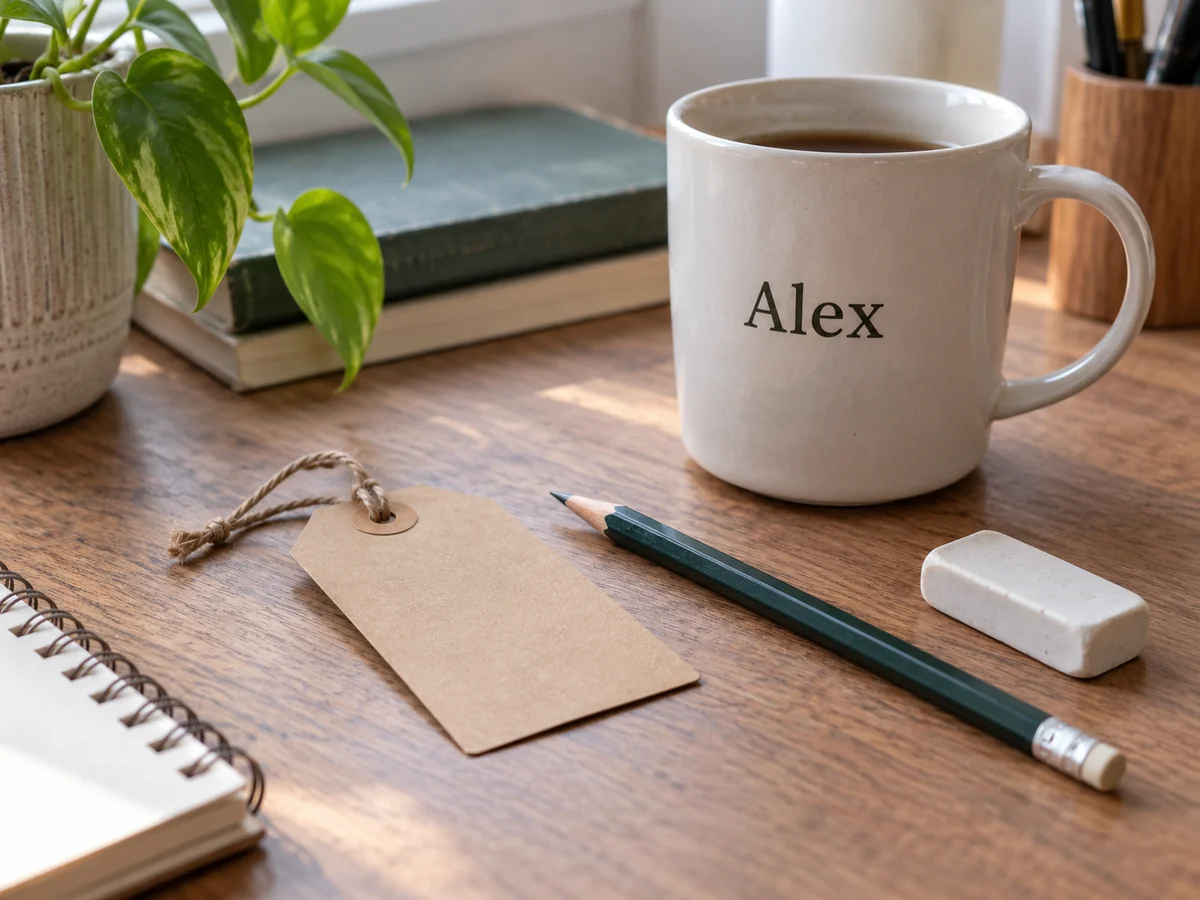
Ask for the version they use
A name can be spelled correctly and still be the wrong choice for a personalised gift. The recipient may use a shortened form, retain an accent, prefer initials or avoid displaying their name on belongings. If you are not sure, ask. A brief question about the preferred version is less awkward than presenting a permanent inscription the person would never have chosen.
Copy the confirmed text carefully rather than relying on memory. Autocorrect can change an unfamiliar name, remove punctuation or replace a deliberate spelling. Check each letter after pasting it into the order field. For dates, confirm the format as well as the numbers: day and month order can be ambiguous across countries. Writing the month in words may help when the design allows it.
Capital letters are part of the instruction
Some designs reproduce the supplied capitalisation; others use a fixed all-capital or lower-case style. Read the listing and examine the preview. If a name includes a hyphen, apostrophe, accent or non-Latin character, confirm that the chosen typeface and production method support it. A plain online form accepting the character does not necessarily prove it will appear correctly on the finished object.
Initials deserve the same care. Their order can differ between a simple line of letters and a particular monogram style. Do not assume the seller follows your preferred convention. Give the exact sequence requested by the maker and check how it is displayed. If the instructions are unclear, resolve the question before ordering rather than adding a vague message and hoping someone interprets it.
Read the proof as though it belongs to someone else
If a proof or preview is available, review the actual text separately from the attractive layout. Read it slowly, then compare it with the confirmed spelling character by character. Check every item in a multi-person order; copying one version across several products can leave an unnoticed name on the wrong colour or size. Keep a record of the approved text and any agreed changes.
Production schedules may separate a proof deadline from a dispatch estimate. Make sure there is time to answer the seller, and use the communication method specified for the order. Do not send conflicting versions through several channels. If you correct something, state clearly which earlier instruction it replaces and ask whether the change was received before production began.
Read the seller's policy for personalised products before paying. An incorrect instruction you approved may be handled differently from a manufacturing error, and an exchange for preference may be limited. The useful precaution is not a legal assumption; it is making the information clear in the first place. Personalisation can be a lovely detail, but a removable note is the better choice whenever the name, spelling or recipient's comfort remains uncertain.