Dry printed clothing without excess heat
Choose the drying method allowed by the garment and the print, then avoid adding heat simply to finish faster.
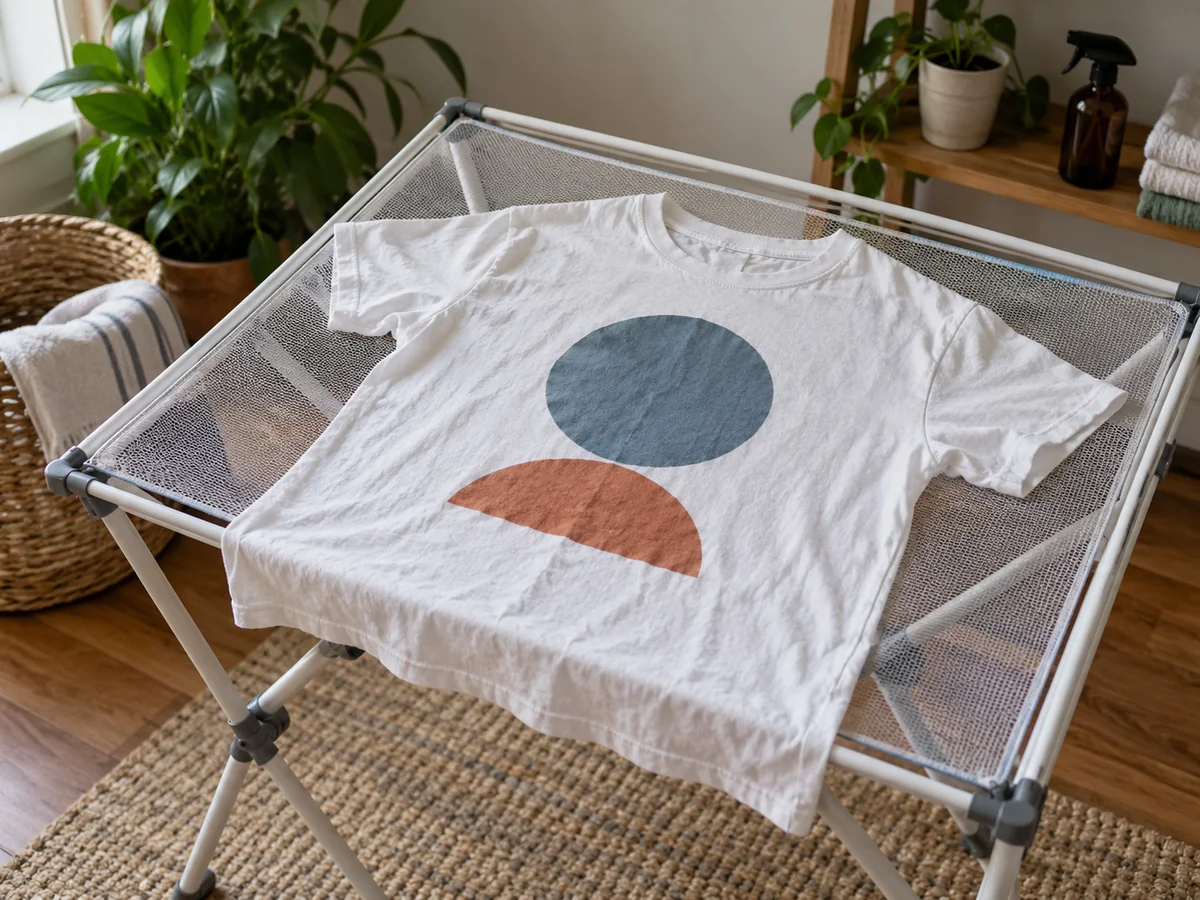
Washing is not the last care decision
A printed shirt can be washed carefully and then exposed to more heat than its instructions allow during drying. Read that part of the label before starting the load. Some decorated garments permit low tumble drying; others specify line drying and prohibit the dryer entirely. A low setting is not a substitute for following a no-tumble instruction.
Check any separate information supplied by the printer as well as the garment label. The base fabric and the applied design may have different limits. If the directions appear to conflict, ask the maker instead of choosing whichever instruction is more convenient.
Support it while it is damp
Remove the shirt from the washing machine promptly and unfold it. Smooth ordinary creases with your hands, without dragging the printed area or stretching the neckline. Damp fabric is not an opportunity to force the garment into a different size. If the shirt has become tangled, separate it gently rather than lifting the whole load by one sleeve.
Use the drying position permitted by the label. On a rack, distribute support so one narrow point is not carrying all the damp weight. If hanging is suitable, avoid pulling the hanger through a close neck opening. Choose a hanger that supports the shoulders rather than creating sharp little peaks.
Place the drying setup where air can circulate. A crowded rack in a closed, damp corner may leave the garment wet for longer. Improve space and ventilation rather than putting an uncertain print against a radiator. Direct contact with a hot surface can be very different from the gentle conditions described on a care label.
Leave the artwork out of the ironing shortcut
Do not press an iron straight onto the graphic to speed the final drying or flatten a stubborn fold. Some printed garments prohibit ironing, while others allow a cool iron away from the print or from the reverse. Use the exact instructions; inside out is not a universal permission to apply heat anywhere.
If tumble drying is allowed, avoid extending the cycle just because other items remain damp. A mixed load can contain fabrics that dry at different rates. Remove finished garments as appropriate to the machine instructions rather than repeatedly overheating the entire load. Let the shirt cool before folding it.
Make sure seams, hems and any thick decoration are fully dry before storage. A shirt that feels dry across the front may retain moisture in folded areas. Drying well is a matter of suitable temperature, support and airflow. It does not require an elaborate routine, but it does require resisting shortcuts that the garment and print were never designed to tolerate.